Sakarit is a Graphic Designer & Visual Artist, based in Brooklyn, NYC





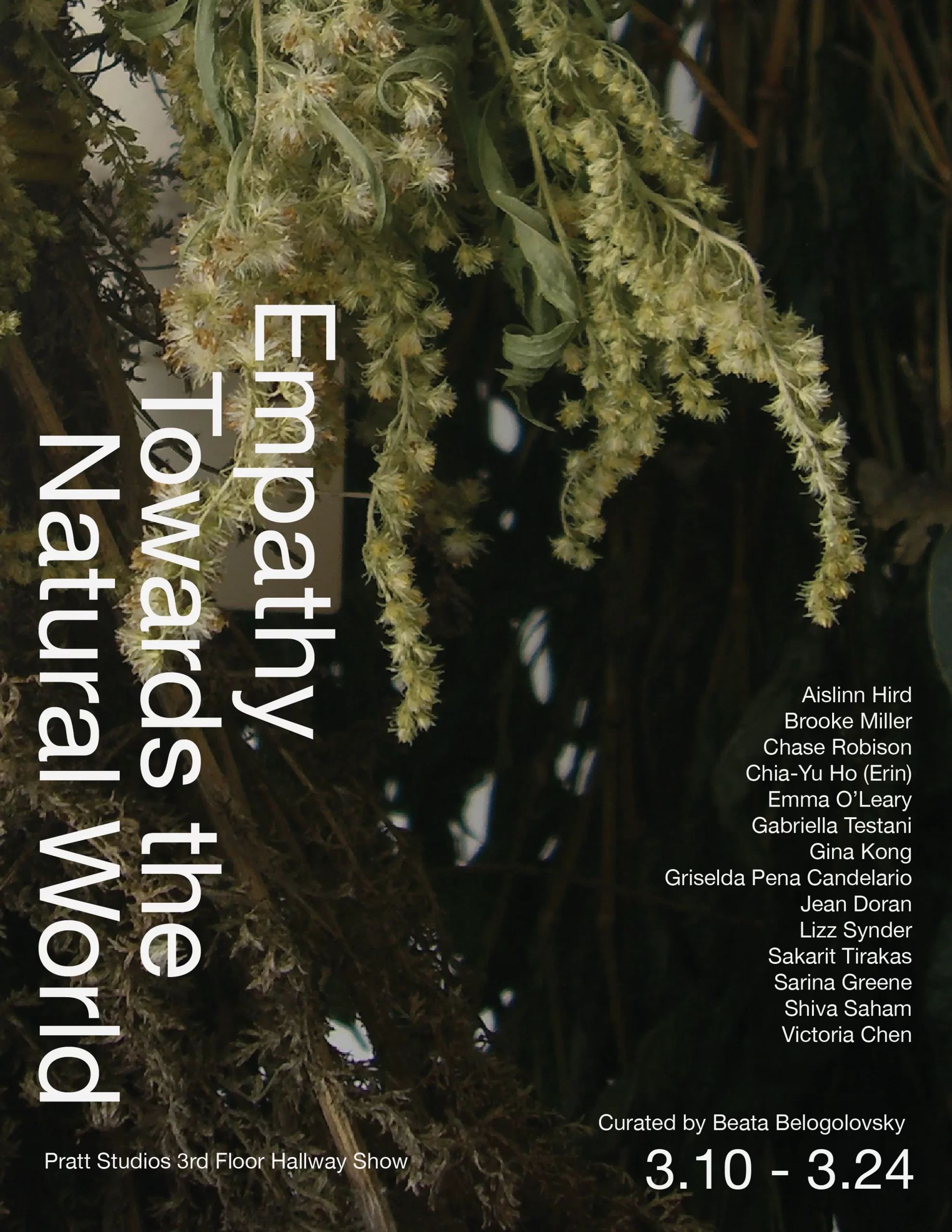
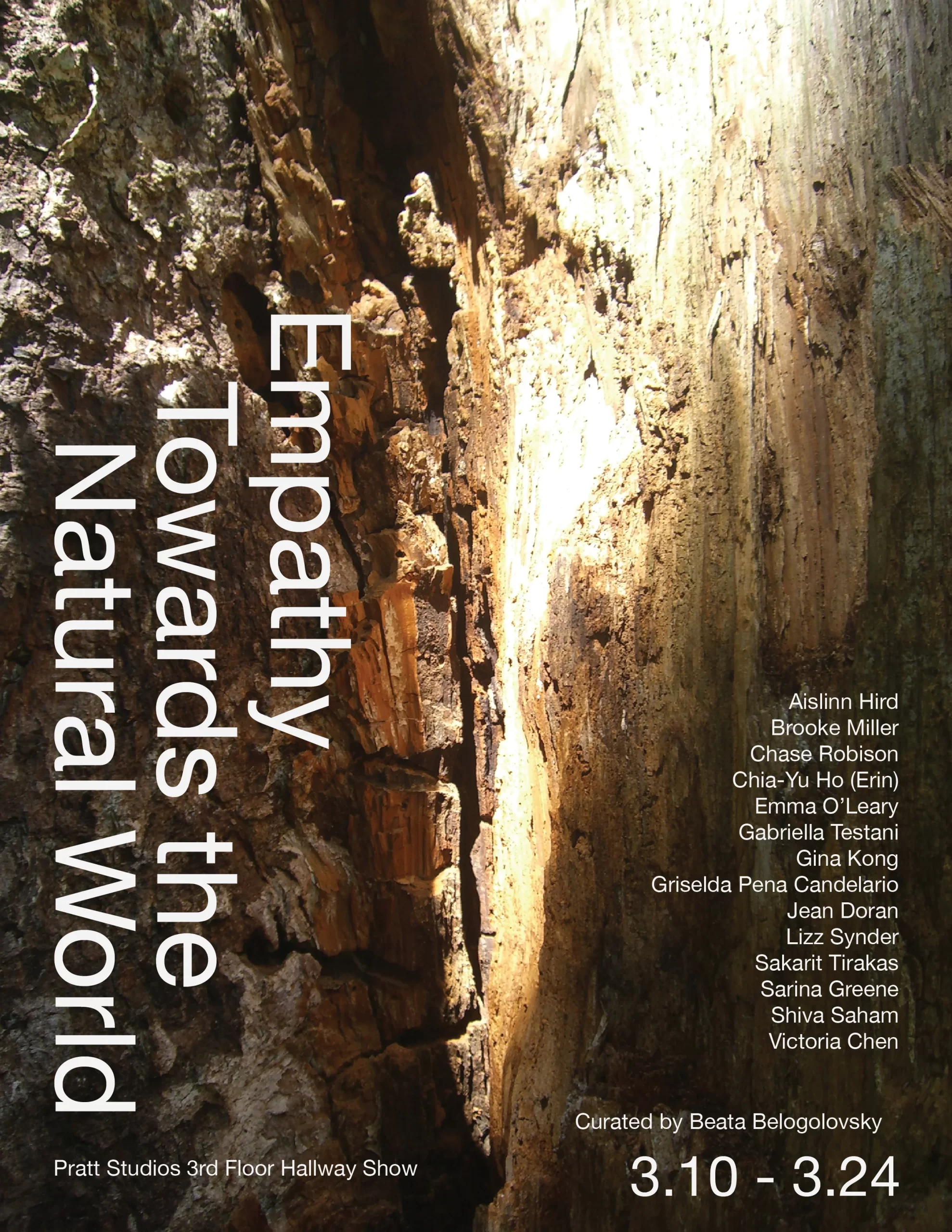
Empathy Towards the Natural World
-
Date:
March 10–24, 2025
-
Location:
3rd fl, Pratt Studios, Juliana Curran Terian Design Center, Pratt Institute, Brooklyn, NYC
This multidisciplinary exhibition aims to bring together individuals at Pratt who are inspired by or committed to the idea of living in a more ecocentric world.
If I could guide you, I would ask that you live life with curiosity, taking the role of an observer. Explore the world around you, appreciating its gifts and wonders. Be curious about the people in your community, engage with your neighbors, and be open to learning from their perspectives. Form a relationship with the world that exists inside your potted plant, in your backyard or local park, and within your neighborhood block.
How can we save a world we’ve forgotten to care for? How do we step away from our habits of seeking immediate gratification, which often distances us from the deeper, slower processes of life and nature? I encourage you to take time to observe how things grow. Growth, in all its forms, is a reflection of time, energy, and patience. The first step to implementing solutions for environmental sustainability is to learn from nature itself, to understand the balance and interconnectedness of all living things.
To make this shift, we must cultivate empathy. Only when we develop a deep respect for the natural world can we begin to align our actions with the care it needs. Empathy allows us to connect with the world around us, motivating us to protect and care for it.
What a desolate place would be a world without a flower! It would be a face without a smile, a feast without a welcome. Are not flowers the stars of the earth, and are not our stars the flowers of heaven?"
— Clara Lucas Balfour (1808-1878), English Author
Participants:
-
Aislinn Hird
Illustration Major + Creative Writing Minor @ash_tree_designs
-
Brooke Miller
Writer @brookeomillerrr
-
Chase Robison
Communication Design BFA, Pratt Institute chaserobison.com
-
Chia-Yu Ho (Erin)
Communications Design MFA, Pratt Institute Erin Ho on Behance | @cadilacer
-
Emma O'Leary
Art and Design Education BFA, Pratt Institute @em.oart
-
Gabriella Testani
Communications Design BFA (Emphasis in Graphic Design), Pratt Institute gabriellatestani.com
-
Griselda Pena Candelario
Fashion Design BFA, Pratt Institute
-
Jean Doran
Communications Design, BFA (Emphasis in Illustration), Pratt Institute 4hoarse.com
-
Lizz Synder
Fashion Design BFA, Pratt Institute @style.troll
-
Sakarit Chankaew
Visual Artist/Graphic Designer, Communications Design, BFA (Emphasis in Graphic Design), Pratt Institute
-
Sarina Greene
Writer/Artist/Poet, Writing BFA, Pratt Institute @sarina.writes
-
Shiva Saham
Drawing BFA, Pratt Institute @shivajoysaham
-
Victoria Chen
Photographer, Photography BFA, Pratt Institute vvictoriacc.com
Sakarit Chankaew
-
Title:
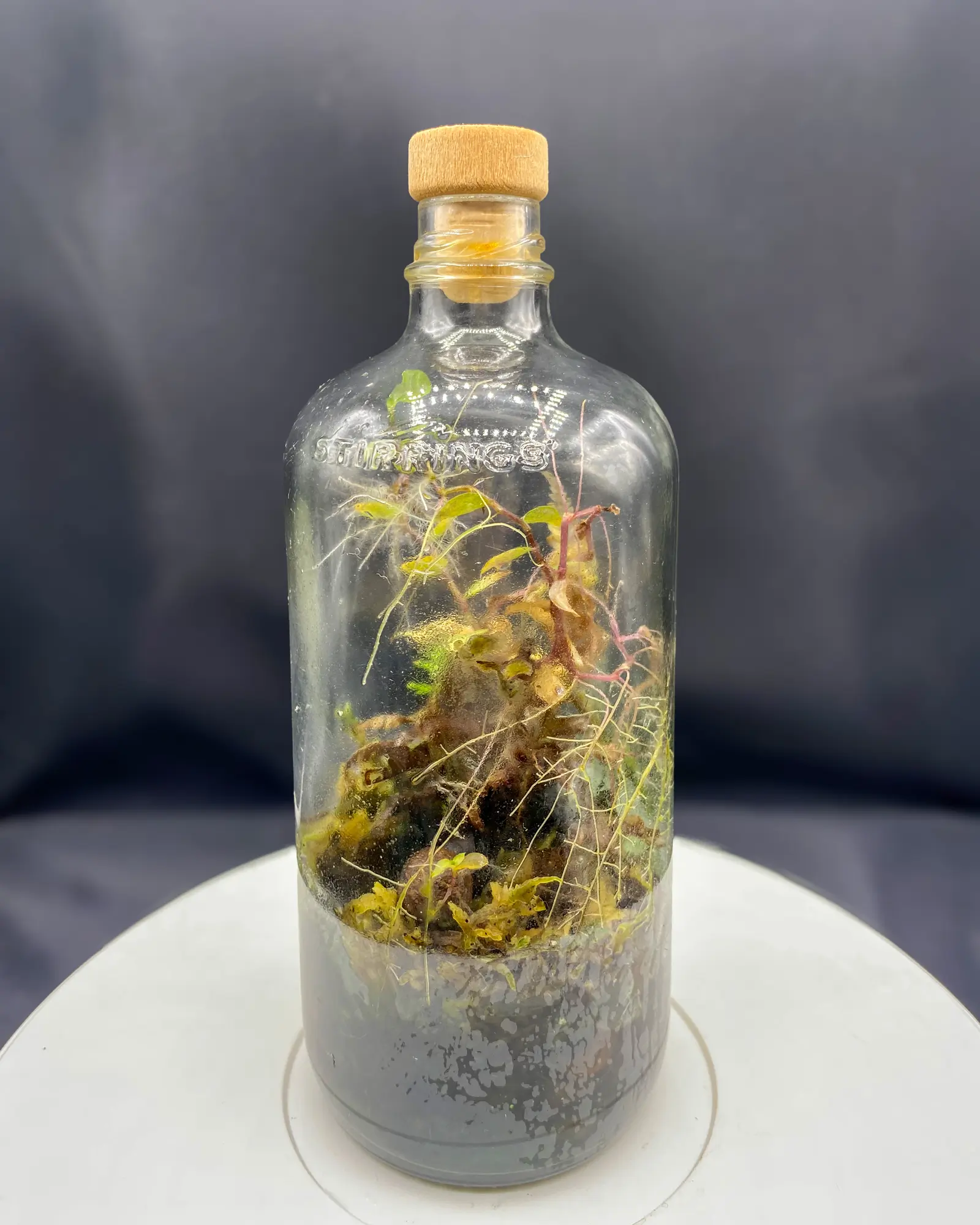
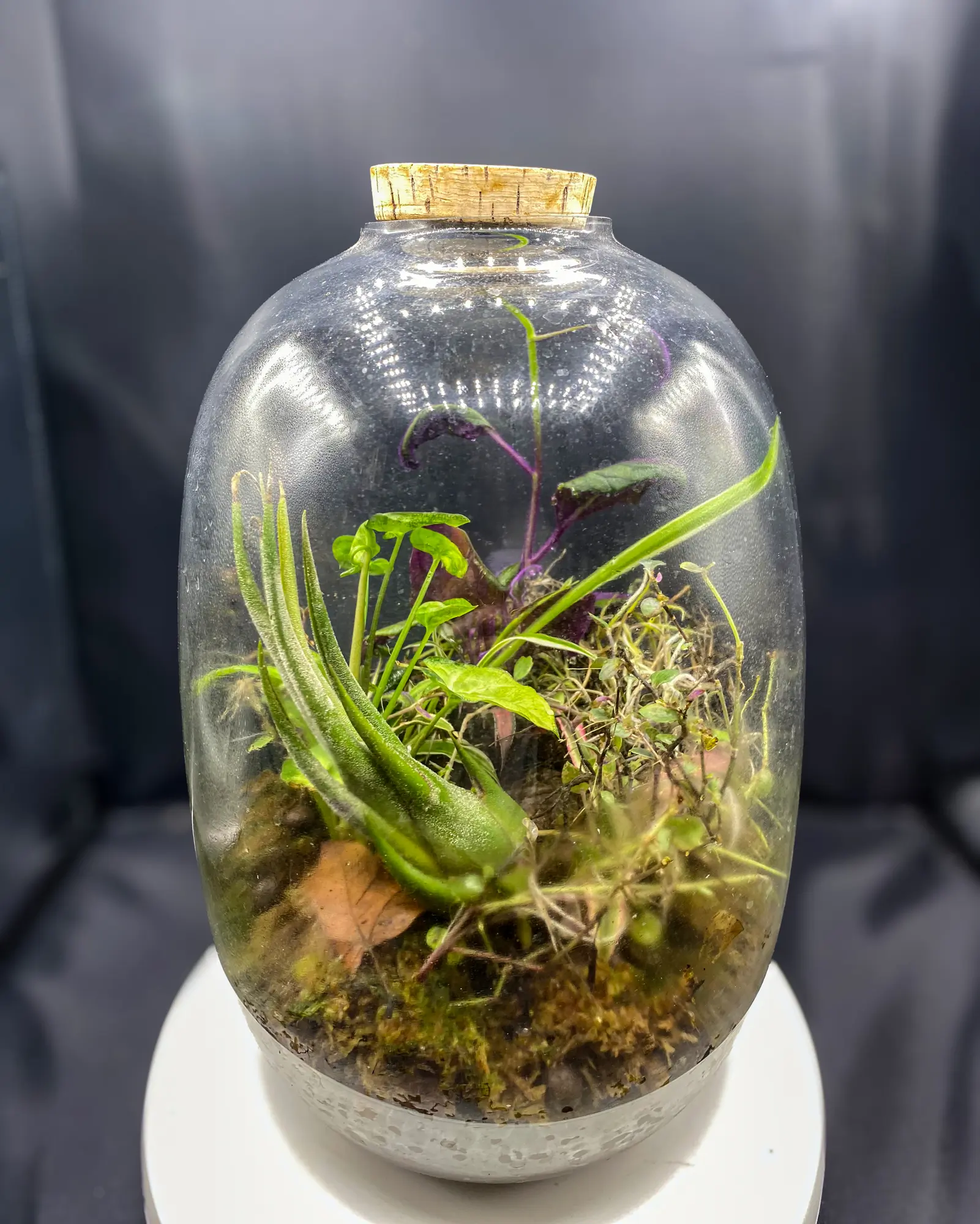
Fairy Gardens (2023-2025)
-
Medium:
Tropical Plants, Moss, Lichen, and Succulents in glass containers.
Over the years, I have been crafting terrariums as part of my creative practice and home decor, while designing captivating paradise gardens in both my backyard and front yard that reflect the charm and intricacy of my terrariums. This practice focuses on repurposing discarded objects to tackle overconsumption and ocean pollution, while embracing the philosophy of “wabi-sabi,” which finds beauty in transience and imperfection. It also focuses on understanding how plants thrive in confined environments, contributing to my long-term goal of creating greenhouses for remote communities to develop and foster sustainable living.
As a designer addressing the climate crisis and trash pollution, integrating used and unwanted materials into both 2D and 3D projects presents unique challenges. However, I believe artists/designers must reconsider the materials they use, prioritizing those that produce minimal emissions. Certain materials, such as plastic, can last for thousands of years. It is far better to repurpose what already exists than to create new materials, as recycling and deconstructing often require significant energy and labor, leading to more emissions. In this project, while using discarded bottles may not represent the most sustainable solution, it is a valuable starting point. It highlights how unwanted objects can be transformed into creations of new beauty, paving the way for more thoughtful and environmentally conscious design.
Coming from a Global South country, I value the beauty of tropical landscapes and plants while being aware of the natural disasters influenced by imperial nations. Now, having moved to New York, a Global North country, I am studying sustainable and environmental design while expanding my knowledge of plants that thrive in various environments, including plains, mountains, plateaus, deserts, and coasts. This knowledge helps me explore how plants can grow in controlled spaces, like bottles or containers, and guides my efforts to design greenhouses and growing spaces for remote communities in harshest conditions.
This project represents more than a creative endeavor—it is a reflection of my commitment to sustainable design and rethinking the potential of discarded materials. I hope to inspire others to see beauty in imperfection and rethink the value of materials often overlooked.
Aislinn Hird
-
Title:
Sunrise and Sunset (2024)
-
Medium:
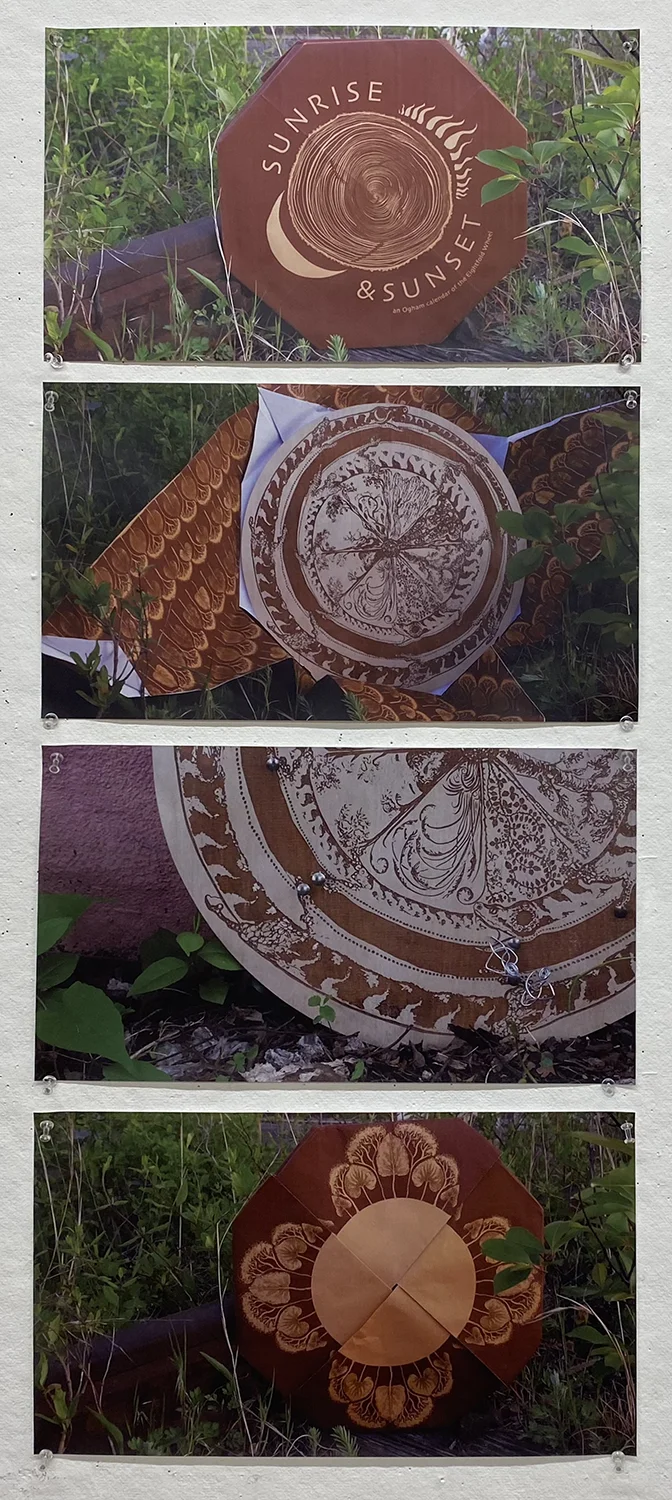
An Ogham Calendar of the (Druidic) Eightfold Wheel, ink drawings and leaf prints laser-etched on birch plywood and printed on 54 x 54 paper, with hand-made wire pegs assembled and edited in Adobe illustrator and Photoshop
-
Description by Artist:
From childhood roots in Druidic tradition, this calendar lustrates the growth and death of each year's life, as represented by the eight celebrations of the year. Each section of the year is represented by an Ogham: a symbolic tree/botanical sharing the name of a proto-Celtic letter in the Ogham alphabet, which builds on each other. The year begins with death al Samhain (known modernly as Halloween) and carries through conception, Incubation, birth, childhood, adolescence, adulthood, middle age, and elderdom. This calendar was made to re-harmonize the artist's circadian rhythm with the seasons and local natural life, and as it is now installed on her wail, it is presented here in photographs taken at Smiling Hogs Head Ranch at dawn in May 2024.
Brooke Miller
-
Title:
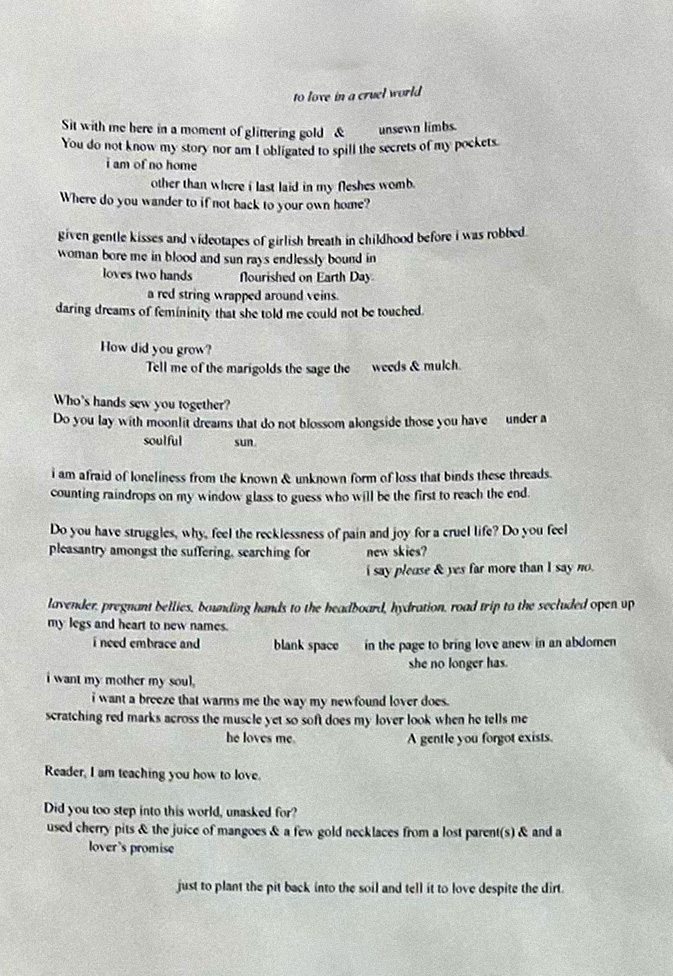
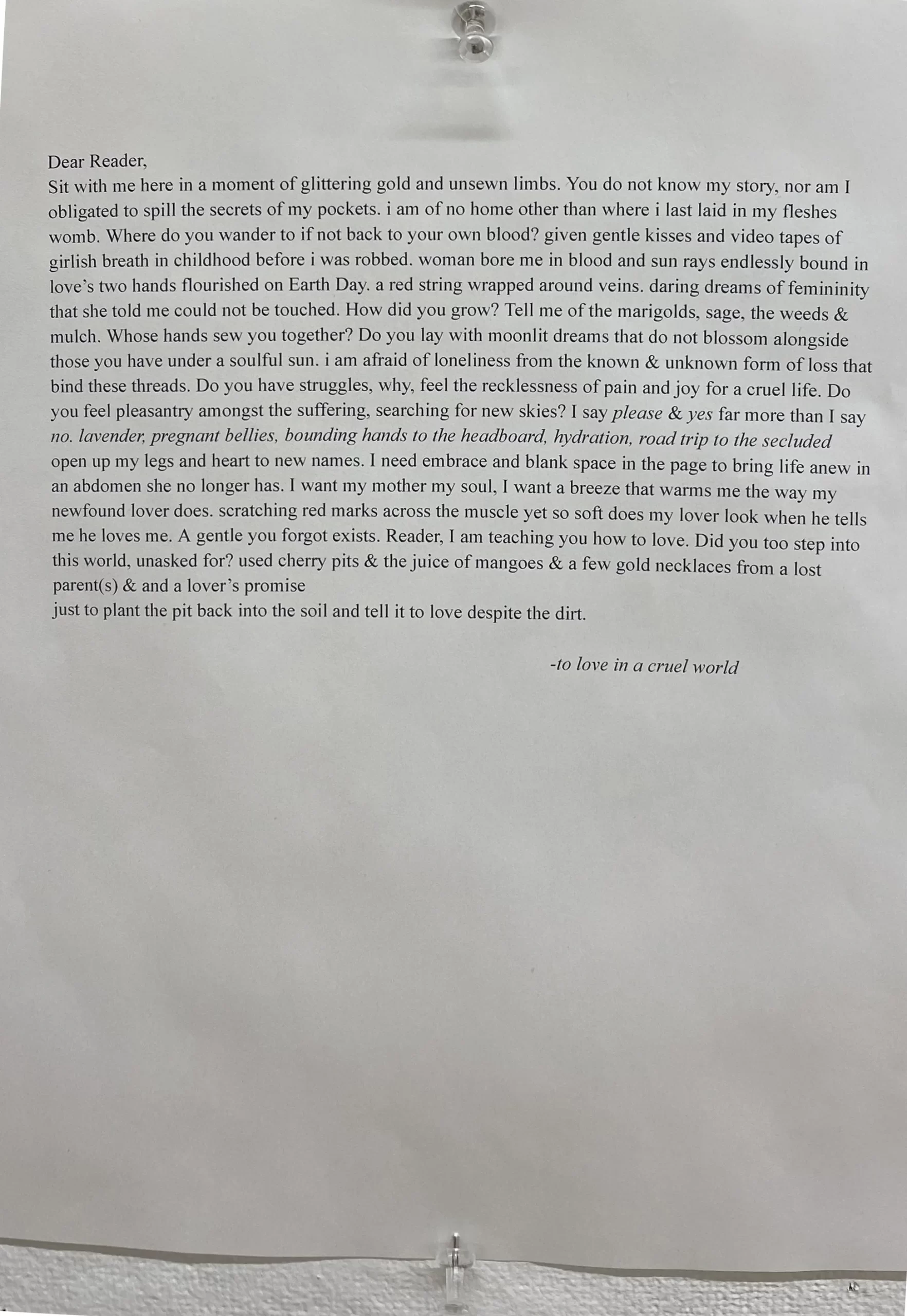
to love in a cruel world
-
Medium:
Prose Poetry
-
Description by Artist:
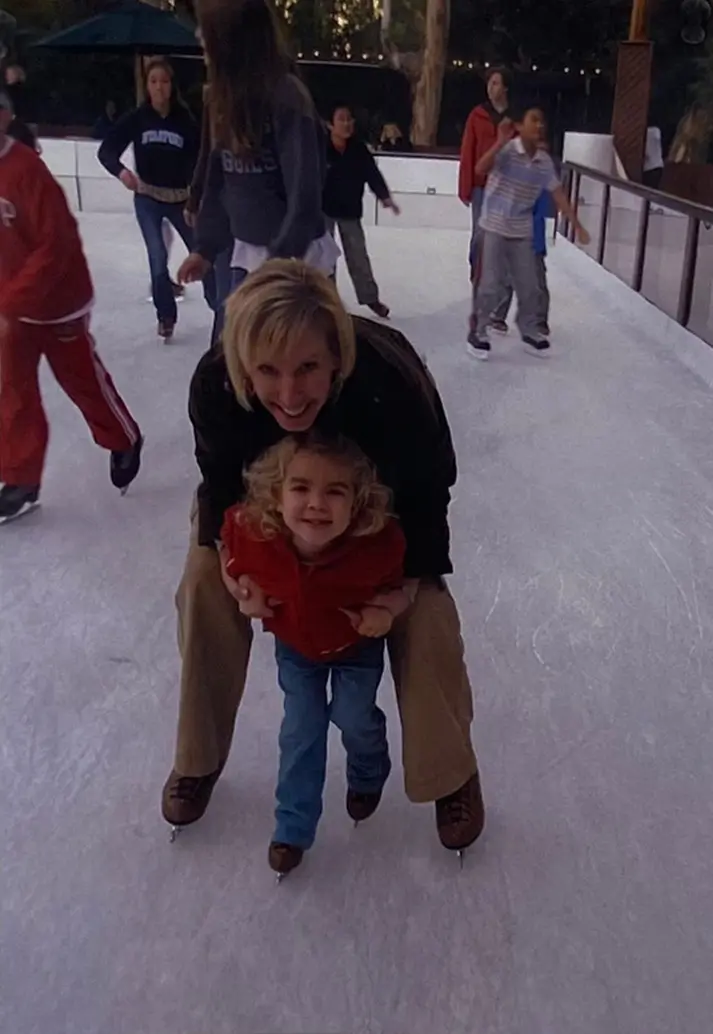
To live in a cruel world touches upon my relationship with my recently passed mother and how one can see the beauty in everyday life despite grief. This piece shadows a mindset on pushing forward in a world of wilting and blooming blurbs through the hardships we experience in this life. The piece asks the readers how they continue to push through the mud and spot the sun and tries to offer a lending hand in helping them find those daily rays.
Chase Robison
-
Communication Design BFA, Pratt Institute
Communication Design Graduate chaserobison.com
-
Title:
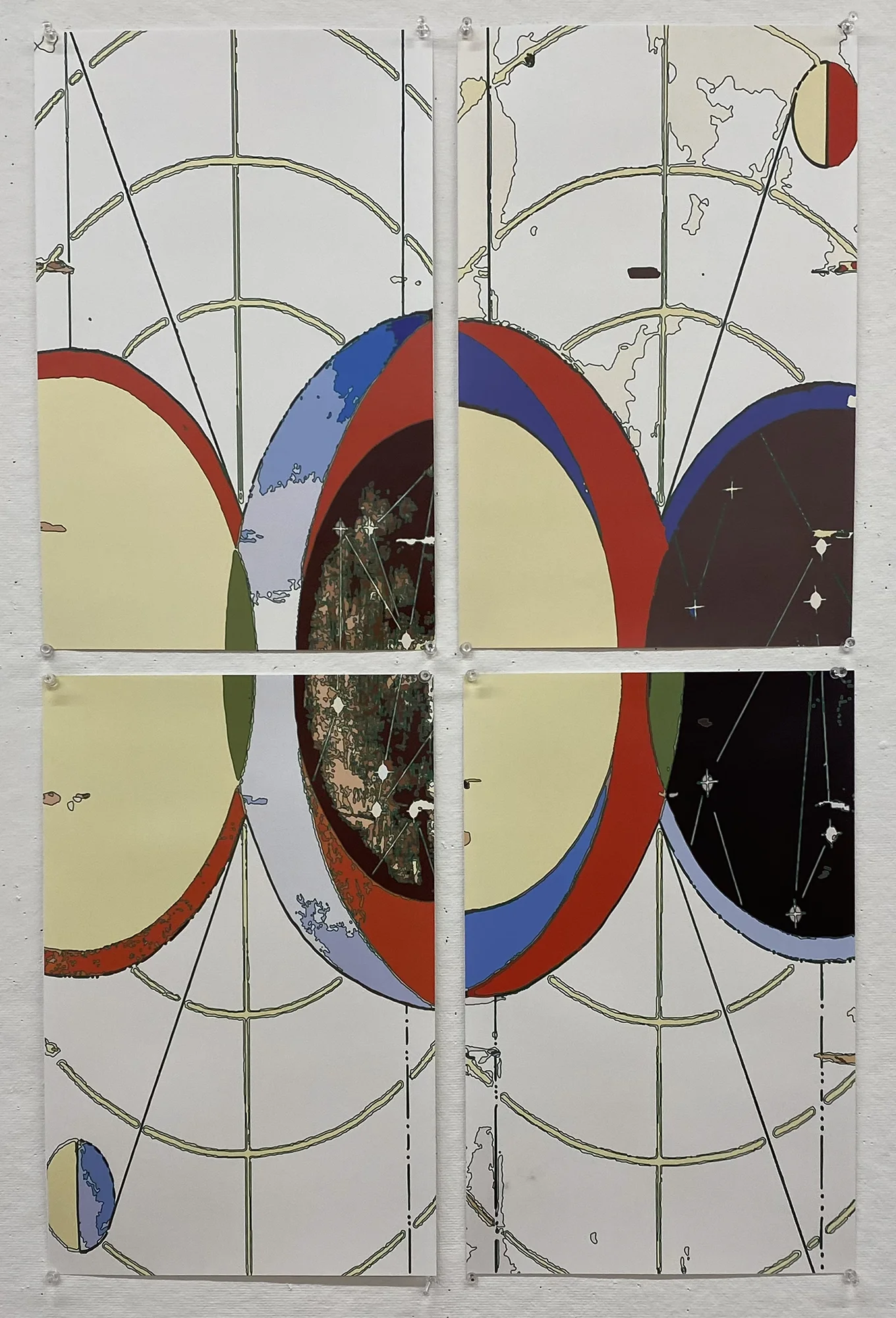
Original Radar (2025)
-
Medium:
Printed scan of acrylic on wood panel.
-
Description by Artist:
The Arctic Tern'a yearly migration from the Arctic Circle to the Antarctic Circle. A journey of about 18,641 miles. Original Radar is a human conception of how an Arctic Tern's sense of internal direction function through magnetoreception, sunlight, and the mapping of the constellations. The Arctic Tern's magnetoreceptive ability takes place on a molecular level in the eye itself. This process happens photochemically, or through the chemical reaction of light and molecular pairs made in the bird's eye. Through this process, it in hypothesized that as long as there la enough light during the day, birds are able to visibly see earth's magnetic field lines. However, this brings awareness to the fact that birds are also capable of identifying specific stars to orient themselves at night.
Chia-Yu Ho (Erin)
-
Title:
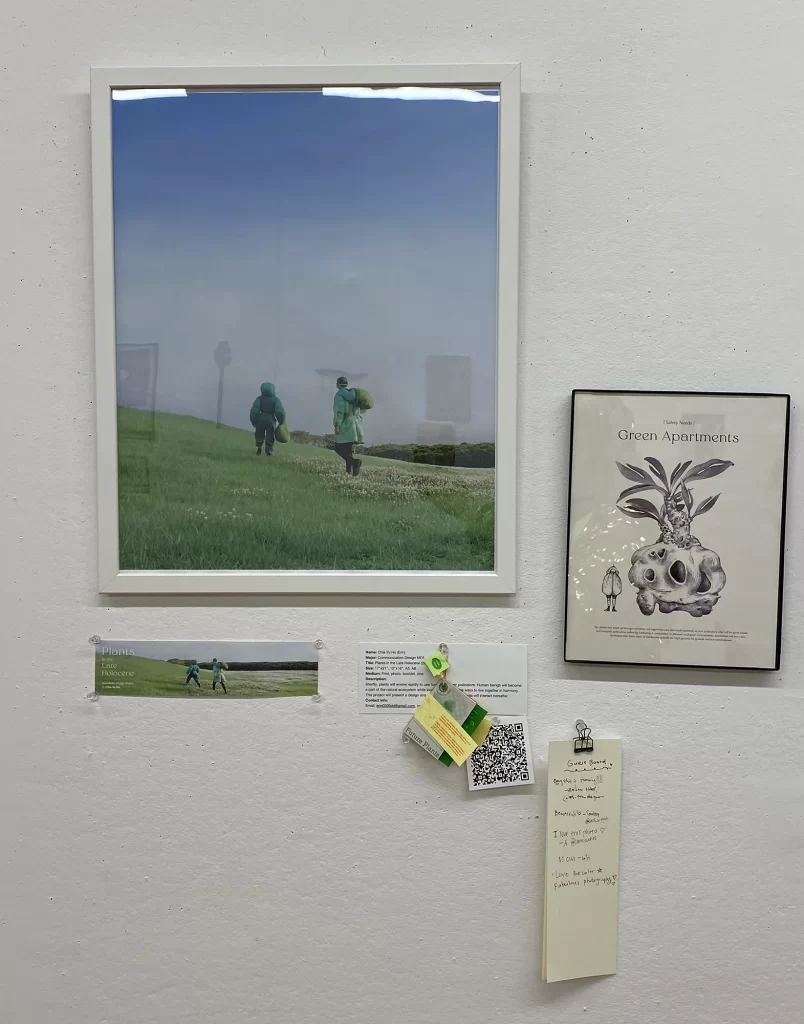
Plants in the Late Holocene (2022)
-
Medium:
Print, Photo, Booklet, Zine
-
Description by Artist:
Shortly, plants will evolve rapidly to use humans as their pollinators. Human beings will become a part of the natural ecosystem while looking for sustainable ways to live together in harmony. This project will present a design and idea of how men and plants will interact hereafter.
Emma O'Leary
-
Title:
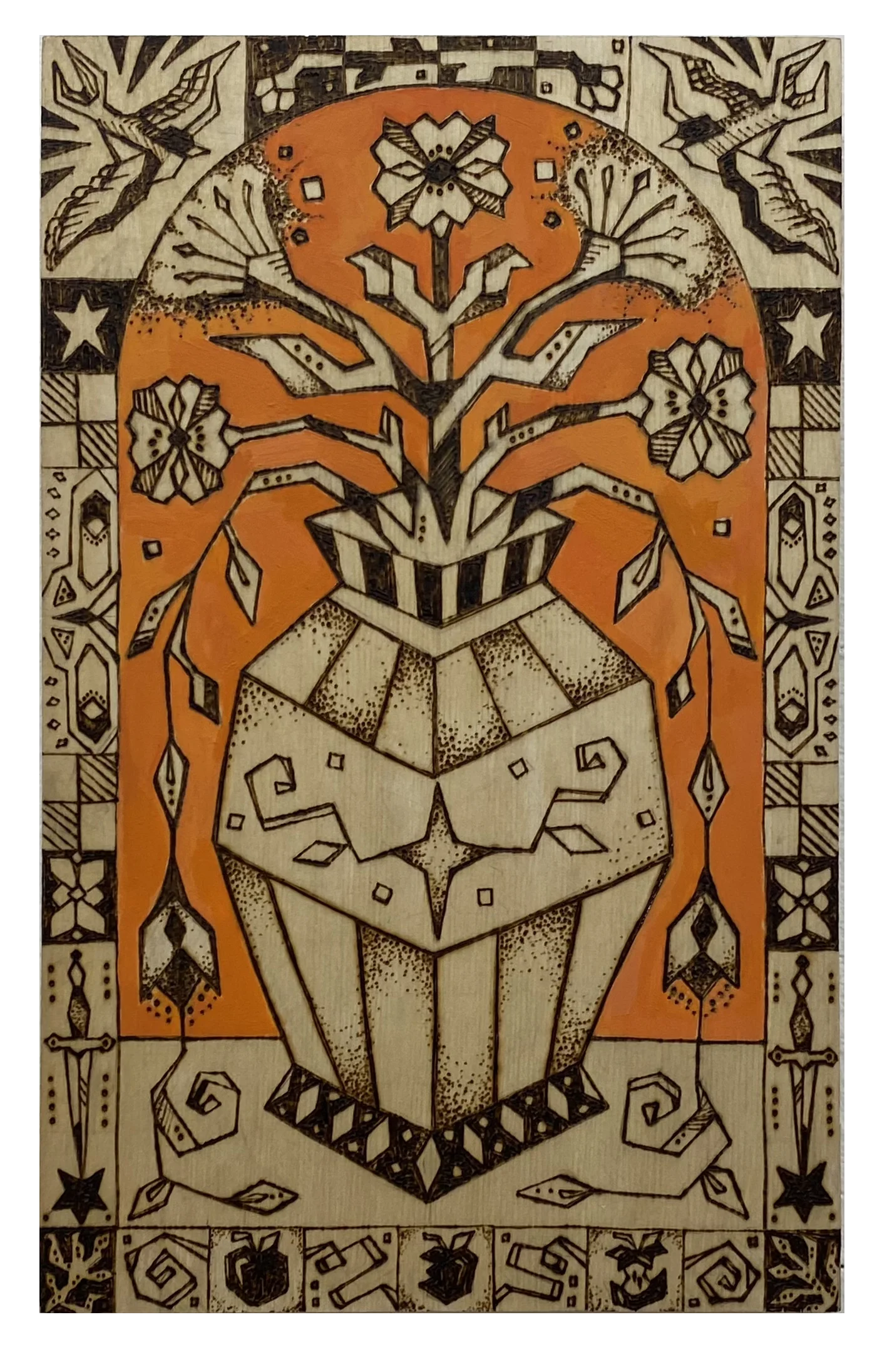
Greco Pot (2025)
-
Medium:
Pyrography and Acrylic paint on reclaimed wood panel
-
Description by Artist:
Throughout my work, I create abstractions of nature in response to my experience with it, often constructing flattened spaces, ornamental designs, and angular depictions. Folk art is a driving force in my practice, both in design qualities and the act of self-teaching.
Gabriella Testani
-
Title:
NeoPlas: Hail To (03/05/25)
-
Medium:
Digital
-
Description by Artist:
In an era where corporate strength increasingly overtly opposes government might, NeoPlas is a chilling examination into the ultimate fate of advanced capitalism. More than just a fictional entity, this epic saga confronts the translucent barrier between corporation dominance and national authority, urging audiences to think about the potential future of planetary hegemonies As giants like Amazon and Meta continue to redefine the landscapes of society, NeoPlas is a sort of extreme experiment in imagination— a theoretical vision of now business may finally transcend boundaries of authority. This fiction of experience envisions a world where corporations and government grow into one another without skipping a beat, revealing the raw clashes of unregulated Institutional power. Save the date: The entire epic arrives this May, with a guarantee to plunge deep into the full world-building.
Griselda Pena
-
Fashion Design BFA, Pratt Institute
-
Title:
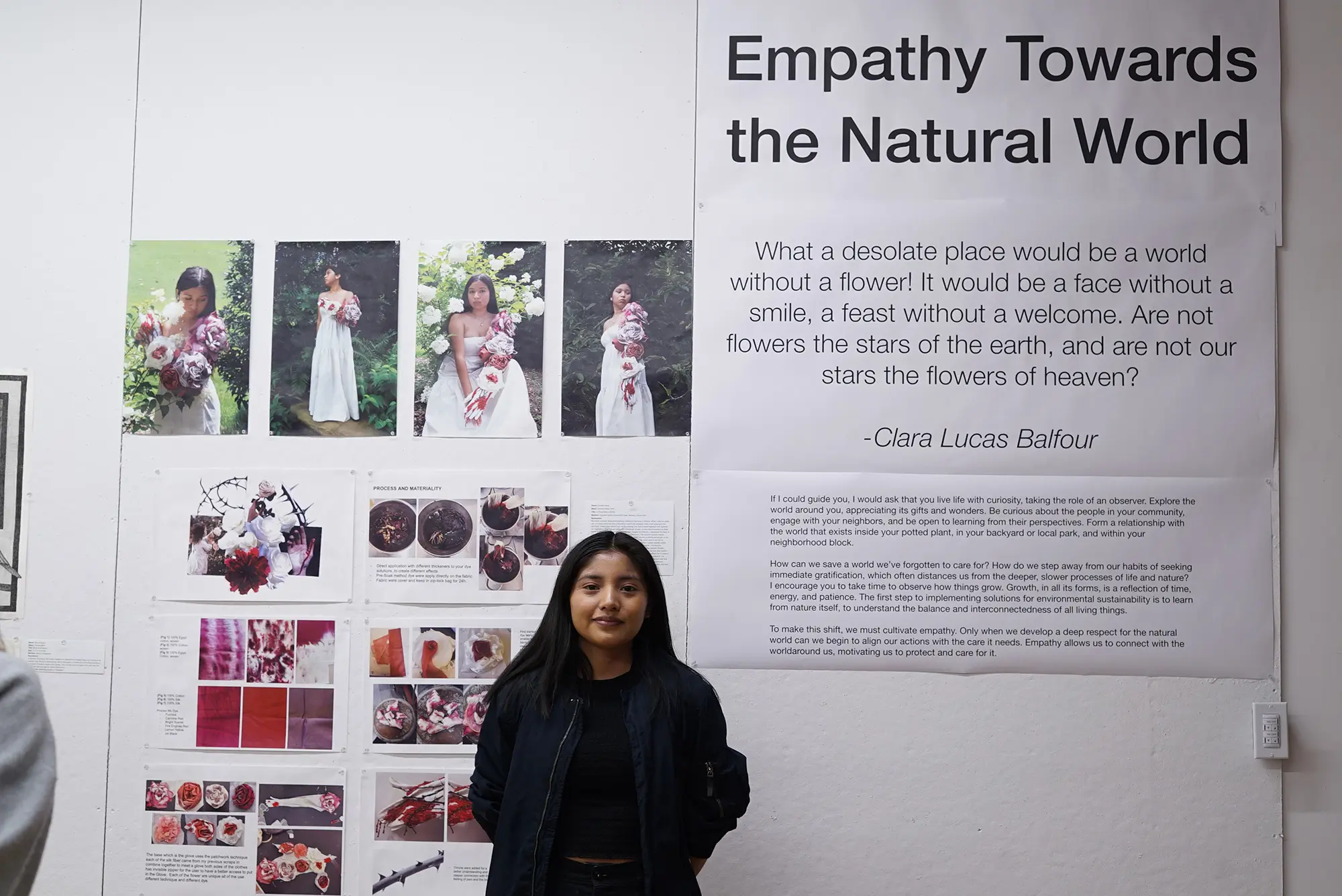
La Rosa Blanca (2024)
-
Medium:
Upcycled fabric, Procion MX Dyes, Beating, Actual thorn
-
Description by Artist:
From childhood roots in Druidic tradition, this calendar lustrates the growth and death of each year's life, as represented by the eight celebrations of the year. Each section of the year is represented by an Ogham: a symbolic tree/botanical sharing the name of a proto-Celtic letter in the Ogham alphabet, which builds on each other. The year begins with death al Samhain (known modernly as Halloween) and carries through conception, Incubation, birth, childhood, adolescence, adulthood, middle age, and elderdom. This calendar was made to re-harmonize the artist's circadian rhythm with the seasons and local natural life, and as it is now installed on her wail, it is presented here in photographs taken at Smiling Hogs Head Ranch at dawn in May 2024.
Discover More


